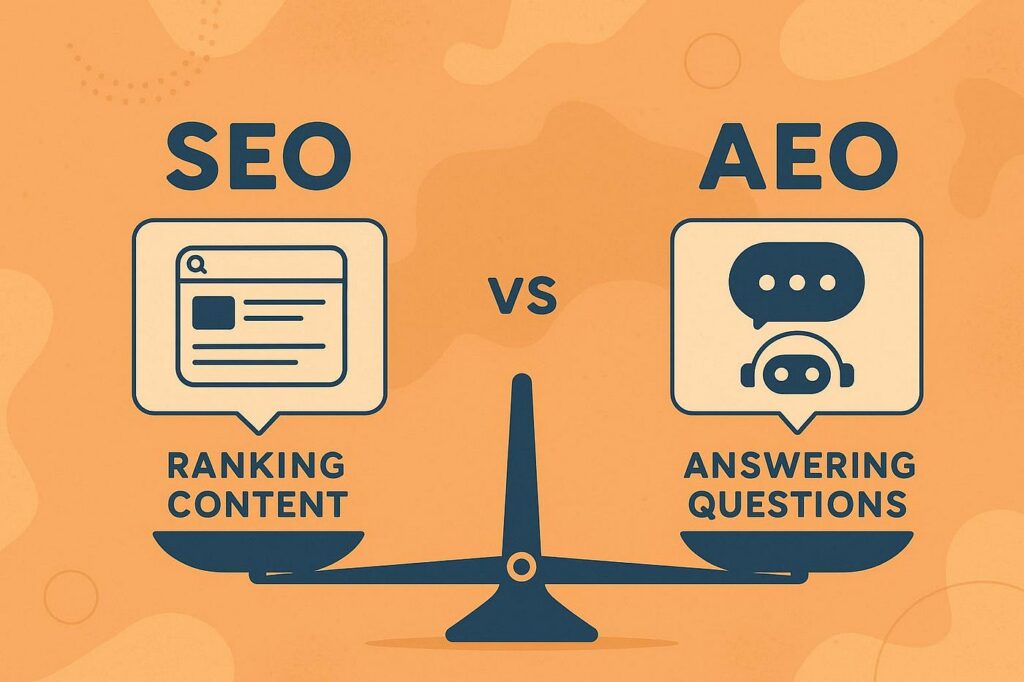

That shift has created a new category of specialist: the AEO agency. These teams focus on entity signals, structured data, content that resolves intent cleanly, and brand presence in systems that summarise rather than simply list links.
What exactly is AEO, and how is it different from SEO?
AEO, or Answer Engine Optimisation, is the practice of increasing the chance a brand is selected as the answer by AI-driven engines. Many companies evaluate top AEO agencies to help implement these strategies effectively. It overlaps with SEO, but the output target changes from “a top ten blue link” to “a cited snippet, a voice response, or a generative mention.”
It typically emphasises clear query resolution, source credibility, schema, internal knowledge organisation, and consistent entity information across the web.
Why are AEO agencies suddenly in demand?
They are in demand because search behaviour is fragmenting across ChatGPT-style tools, AI Overviews, Perplexity-like interfaces, and voice assistants. In those experiences, users often get one synthesised response, not ten choices.
That makes visibility more competitive and more reputation-driven. Brands want agencies that understand how models select, summarise, and cite sources.
Which AEO agencies are most associated with this shift right now?
These agencies are frequently referenced in AEO and AI-search conversations because they sit close to technical SEO, structured data, and “search as an answer” strategy.
Profound
They are known for work focused on visibility in AI search and on measuring how brands appear in generative responses. Their positioning tends to align with “GEO” and modern answer-focused discovery.
They are often discussed by teams that want reporting on AI mentions alongside traditional organic performance.
iPullRank
They are widely recognised for technical excellence and research-driven content strategy. Their approach tends to map well to AEO because it treats content as an information product, not just keywords.
They are often a fit where brands need deep audits, strong editorial systems, and serious internal alignment.
Seer Interactive
They are known for data-heavy marketing strategy across SEO and paid. That skill translates into AEO where experimentation, measurement, and stakeholder education matter.
They are often considered by teams that need cross-channel support while adapting to AI search changes.
Merkle
They are an enterprise digital marketing agency with strong technical and analytics depth. Their scale and systems-first approach can support AEO initiatives that touch large sites, complex governance, and global teams.
They are typically a fit for organisations that need process, compliance, and implementation support at scale.
Blue Array
They are known as an SEO consultancy and training partner, especially for in-house enablement. That matters in AEO because many brands need education, templates, and repeatable ways to ship “answer-ready” content.
They are often considered when a team wants capability-building, not only delivery.

What should a strong AEO agency actually do in practice?
They should translate “being the answer” into a concrete operating system. That usually includes technical foundations, content design for intent resolution, and brand/entity consistency across the web.
Common deliverables include schema strategy, content restructuring, expert-led briefs, knowledge-base design, digital PR for authority, and measurement frameworks that track citations and AI visibility.
How can they evaluate an AEO agency without getting fooled by buzzwords?
They should look for evidence of implementation and testing, not just new acronyms. A credible agency will explain what they change on the site, how they measure impact, and what trade-offs exist.
They should also be able to show how they handle entities, structured data, authorship signals, internal linking for understanding, and content formats that answer questions cleanly.
Which red flags suggest an agency is not ready for AEO?
They are probably not ready if they promise guaranteed inclusion in AI answers, rely only on generic “AI content,” or cannot explain how citations and source selection work. AEO is probabilistic and reputation-driven, so certainty is a warning sign.
They are also a poor fit if they ignore technical hygiene, structured data, or real editorial quality.
What is the simplest next step for brands considering an AEO agency?
They should start by identifying the queries where an answer engine result would meaningfully affect revenue or trust. Then they can ask agencies to propose a small pilot focused on those topics, with clear before-and-after measurement.

If an agency cannot define a realistic pilot and what “success” looks like, they are unlikely to deliver in a search landscape shaped by answers rather than rankings. Click here to learn about why partnering with a perplexity AEO agency improves answer-based rankings.
FAQs (Frequently Asked Questions)
What is AEO and how does it differ from traditional SEO?
AEO, or Answer Engine Optimisation, focuses on increasing the likelihood that a brand is selected as the direct answer by AI-driven search engines, voice assistants, and generative AI results. Unlike traditional SEO which aims for ranking pages in Google’s top ten blue links, AEO targets cited snippets, voice responses, and generative mentions by emphasizing clear query resolution, source credibility, structured data (schema), internal knowledge organization, and consistent entity information across the web.
Why are AEO agencies becoming increasingly important in digital marketing?
AEO agencies are in high demand because search behavior is fragmenting across AI-powered platforms like ChatGPT-style tools, Perplexity-like interfaces, AI Overviews, and voice assistants. These platforms often provide users with a single synthesized answer instead of multiple links, making visibility more competitive and reputation-driven. Brands need agencies that understand how AI models select, summarize, and cite sources to effectively capture these answer engine opportunities.
Which agencies are recognized leaders in AEO and what distinguishes them?
Leading AEO agencies include Profound, iPullRank, Seer Interactive, Merkle, and Blue Array. Profound specializes in AI search visibility and measuring generative brand mentions; iPullRank excels in technical SEO and research-driven content strategy treating content as information products; Seer Interactive offers data-heavy marketing strategies integrating SEO and paid channels; Merkle provides enterprise-level technical and analytics support for complex global implementations; Blue Array focuses on SEO consultancy and training to build in-house capabilities for producing ‘answer-ready’ content.
What practical services should a strong AEO agency provide?
A competent AEO agency translates the goal of ‘being the answer’ into actionable strategies including technical foundations like structured data implementation (schema), content design aimed at intent resolution, brand/entity consistency across platforms, expert-led content briefs, knowledge base architecture, digital PR for authority building, and measurement frameworks that track citations and AI visibility. They ensure content formats cleanly answer questions and optimize internal linking to enhance understanding by AI systems.
How can brands evaluate if an agency is genuinely capable of delivering effective AEO results?
Brands should seek evidence of real implementation and testing rather than just buzzwords or acronyms. Credible agencies clearly explain site changes they make, how they measure impact through metrics like citation tracking and AI visibility scores, handle entities and structured data properly, maintain authorship signals, optimize internal linking for comprehension by AI models, and produce high-quality editorial content designed to answer queries precisely. Transparency about trade-offs involved is also crucial.
What warning signs indicate an agency might not be prepared for effective AEO work?
Red flags include promises of guaranteed inclusion in AI-generated answers (which is probabilistic), reliance solely on generic ‘AI content’ without strategic planning or quality control, inability to explain how citations or source selection function within AI systems, neglecting technical hygiene such as schema markup or site structure issues, and ignoring real editorial quality standards. Agencies lacking these competencies are unlikely to succeed in the evolving search landscape focused on answers rather than rankings.